
Researchers at NIT Rourkela have patented a novel hybrid energy-storage system designed to significantly improve the efficiency and lifespan of electric vehicle batteries. This innovation addresses common issues like low power density and thermal stress by integrating supercapacitors with a simplified architecture, making EVs more reliable, especially in urban driving conditions.

JSW MG Motor India has unveiled ADAPT, India's first multi-powertrain new energy vehicle (NEV) platform, designed to support electric, hybrid, plug-in hybrid, and range-extender electric vehicles. The company plans to launch one electric SUV and one plug-in hybrid SUV based on this architecture during FY27, aiming to broaden its NEV portfolio and accelerate adoption in India.

Mercedes-Benz India is exploring a larger role for plug-in hybrid electric vehicles (PHEVs) in its portfolio, with plans to potentially introduce the technology in more models beyond the newly launched S-Class plug-in hybrid. This strategy aims to cater to luxury car buyers who are hesitant about fully electric vehicles due to concerns over charging infrastructure and range.

JSW Group and China's SAIC Motor are in discussions for the next round of capital support for JSW MG Motor India, aiming to expand manufacturing capacity beyond 220,000 units annually to an ambitious one million vehicles and broaden its new-energy vehicle (NEV) portfolio.
Government wants to encourage manufacturing and selling of alternative fuel-based vehicles.

Maruti Suzuki Chairman R C Bhargava is pushing for increased government incentives for biogas-powered vehicles over hybrids, emphasising their net-zero carbon emissions and the valuable organic manure they produce, while also advocating for continued GST benefits for electric vehicles.

Nissan Motor India aims to achieve a fourfold increase in domestic sales, targeting 100,000 units annually, and export another 100,000 vehicles from its Chennai plant by financial year 2027-28 (FY28), marking a significant revival of its presence in the Indian passenger vehicle market.

Joint crack team of Maruti, Tata Motors, M&M to develop hybrid cars in India

The Delhi government has approved the Delhi EV Policy 2.0, which will phase out fresh registrations of internal combustion engine (ICE) two-wheelers and three-wheelers over the next two years, starting with a ban on ICE 3Ws and N1 category LCVs from January 1, 2027, and ICE 2Ws from April 1, 2028.

Honda is re-entering the Indian market with the ZR-V, a premium hybrid SUV designed to be a halo product and showcase its global line-up, despite its high import price and some missing features.

'Now that all the early adopters have the electric car, governments are backing down in some countries because they do not have the money to subsidise so much.'

In the e2W category, which accounts for more than 60 per cent of total EV sales, volumes fell 15 per cent to 118,944 units in November, compared to 139,787 units in the previous month

The national budget 2019-20 had an outlay of Rs 10,000 crore for Phase-II of the Faster Adoption and Manufacturing of Hybrid and Electric Vehicles scheme to boost electric mobility and increase the number of EVs in commercial fleets.

India's flagship motor show Auto Expo 2023 kicked off on Wednesday with the global unveiling of Suzuki Motor Corporation's concept electric SUV 'eVX' which is slated to hit the market by 2025. The company's Indian arm Maruti Suzuki India is among the major manufacturers participating in the show that has returned after three years. The Concept eVX is a mid-size electric SUV concept designed and developed by Suzuki Motor Corporation (SMC), Japan. It will be powered by a 60 kWh battery pack offering up to 550 km of driving range on single charge.
Arun Jaitley presented the Budget in Parliament on Saturday.
Grant Thornton Bharat's latest survey indicates that hybrids are set to consolidate market share this festive season, bridging the gap between conventional petrol engines and the emerging electric vehicle segment.
A series of flip-flop on policies and a non-existent charging infrastructure are the biggest challenge in achieving the target of selling 6-7 million hybrid and electric vehicles by 2020.
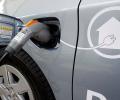
At a time when consumers increasingly embrace green mobility solutions, it is not electric cars but hybrids that are taking the lead, as automotive sales data indicate. Since January, 64,097 electric cars have been sold compared to 266,465 hybrids, according to data from the ministry of road transport and highways' Vahan dashboard. Hybrid car sales have surged from 4.42 per cent of the 4.1 million cars sold in calendar year 2022 to 7.2 per cent this year.
Future strategy will not just revolve around EVs: Maruti Suzuki's Ayukawa. Maruti Suzuki's MD&CEO says electric vehicles cannot be a solution outside the cities.

Maruti will showcase its first concept electric vehicle, the e-SURVIVOR; M&M it's six new EVs, including two futuristic concepts
At a time when consumers increasingly embrace green mobility solutions, it is not electric cars but hybrids that are taking the lead, as automotive sales data indicate. Since January, 64,097 electric cars have been sold compared to 266,465 hybrids, according to data from the Ministry of Road Transport and Highways' Vahan dashboard. Hybrid car sales have surged from 4.42 per cent of the 4.1 million cars sold in calendar year 2022 to 7.2 per cent this year.
Ministries such as road transport and heavy industries are learnt to have objected to NITI Aayog's attempts to become an implementing body for the EV programme.

'I am now driving an electric vehicle. I have lost faith in petrol-run cars.'
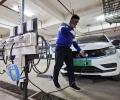
New Delhi's timing couldn't have been worse, both for India's fledgling electric vehicle (EV) sector and prospective electric bike buyers. It was hard to miss the perfect storm brewing for India's EV industry since early 2022. On one hand, you had several accidents involving battery fires that unnerved consumers; on the other, uncertainty had crept in over subsidies.

German Car maker Audi plans to offer cars that can do 400 km on a single charge, says Ajay Modi.

With Budget concessions in place to propel the Indian automobile industry on a green drive, manufacturers are planning electric and hybrid variants of cars and two-wheelers.

EV manufacturers point out that converting a regular petrol car into a flex-fuel vehicle requires only about Rs 17,000-25,000 per unit, whereas developing an EV demands vastly greater investments in research, battery development, and localisation.
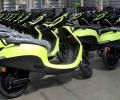
India's electric two-wheeler (e2W) manufacturers have urged the government to extend subsidies under the PM E-Drive (Electric Drive Revolution in Innovative Vehicle Enhancement) scheme beyond March 2026, cautioning that a withdrawal could slow near-term demand even as confidence in long-term electric mobility adoption remains intact.

The investment will be made through a joint venture with Toshiba and Denso. The battery is the most expensive single part of an EV.

Indian car buyers care more about affordability than technology, keeping ICE vehicles dominant while hybrids emerge as the preferred transition option and EVs struggle in the mass market.
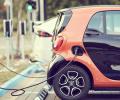
Despite the benefits of hybrid technology, a lack of government backing and few launches have kept the segment from gaining ground.
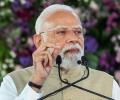
A day before US President Donald Trump's additional 25 per cent tariff kicks in, Prime Minister Narendra Modi on Tuesday made a vehement pitch for swadeshi and Make in India that should help create jobs in the country.
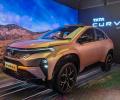
India's electric passenger vehicle market saw an 87.4 per cent year-on-year increase in FY26, reaching 233,246 units, primarily driven by the mid-size SUV segment (20-30 lakh price bracket), while the entry-level segment (sub-10 lakh) experienced a decline.

The Renault group is set to significantly expand its presence in India, aiming to establish the country as one of its top three global markets by 2030 through the launch of seven new vehicles, a 5 per cent market share target, and ambitious export goals.
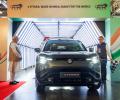
Japanese automaker Suzuki Motor Corporation will invest Rs 70,000 crore in the next five to six years in India to strengthen its operations in the country, its representative director and president Toshihiro Suzuki said on Tuesday. Prime Minister Narendra Modi on Tuesday kicked off exports of Maruti Suzuki India's first electric vehicle e VITARA to 100 countries and also inaugurated the production of lithium-ion battery cells for strong hybrid electric vehicles at its facility in Gujarat.

Maruti Suzuki will introduce eight SUVs over the next five years taking its overall model range to 28 as it aims to regain 50 per cent market share in the domestic passenger vehicle segment, Suzuki Motor Corporation Representative Director and President Toshihiro Suzuki said on Wednesday.
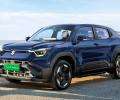
Maruti Suzuki's e-Vitara marks its high-stakes EV debut with strong export ambitions, lifting its stock even as analysts caution over pricing and fierce competition.

'In terms of incentives, if you think about it, hybrids are a 20-year-old technology.'

While SUVs have steadily gained share across the industry, data shows that nearly three in 10 luxury vehicles sold in India are sedans, highlighting the segment's resilience despite years of SUV-led growth.

JSW MG Motor India will launch four new models this year, and is planning to invest between 3,000 crore-4,000 crore in the country over the next couple of years. The new models include a plug-in hybrid, an electric vehicle, the Majestor SUV and one additional model yet to be disclosed.
